Trump’s Truth Social Post Comparing Himself to Jesus Sparks Controversy After Attack on Pope Leo
A recent social media post by Donald Trump has ignited widespread debate across the United States after the president criticized Pope Leo XIV and then shared an AI-generated image portraying himself in a Christ-like role.
The posts, published on Trump’s platform Truth Social, quickly spread across social media and news outlets, prompting reactions from political leaders, religious figures, and the public.
The episode highlights the growing tension between Trump and the Vatican while also raising broader questions about political rhetoric, religion, and the role of social media in modern politics.
The Social Media Post That Started the Controversy
Late on a Sunday evening, Trump posted a lengthy message criticizing Pope Leo XIV, accusing the pontiff of being “weak on crime” and “terrible for foreign policy.” (FOX 9 Minneapolis-St. Paul)
The criticism came after the pope had delivered remarks calling for peace and warning about what he described as the dangerous “delusion of power” fueling international conflicts.
Trump argued that the pope was interfering in political matters and suggested the religious leader should focus more on spiritual leadership rather than global politics.
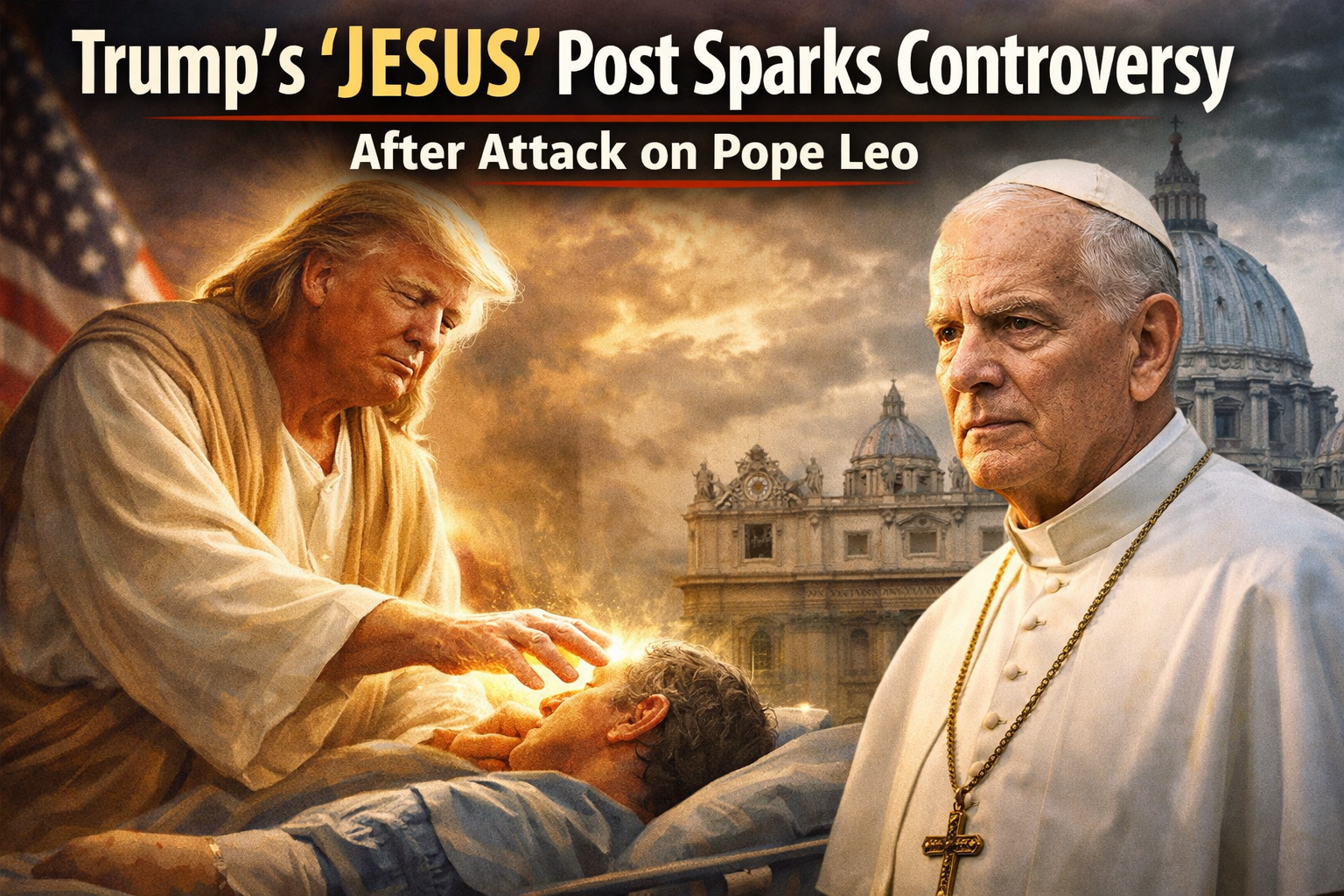
Shortly after publishing that criticism, Trump shared an AI-generated image showing himself dressed in robes resembling traditional depictions of Jesus, appearing to heal a sick person with a glowing hand. (Moneycontrol)
The image circulated rapidly online, becoming one of the most discussed political posts of the week.
Escalating Tensions Between Trump and the Vatican
The dispute between Trump and Pope Leo did not begin with the social media post.
In recent months, the Chicago-born pontiff—the first American-born pope in modern history—has spoken openly about issues including:
- Global conflicts and military escalation
- Immigration and humanitarian policies
- The moral responsibilities of world leaders
These remarks have sometimes been interpreted as indirect criticism of U.S. policy under Trump.
In response, Trump has repeatedly argued that religious leaders should avoid interfering in political decisions.
During his Truth Social post, he claimed that the pope’s positions on global issues show poor judgment on matters like crime and international security. (FOX 9 Minneapolis-St. Paul)
The AI Image and Why It Sparked Backlash
The AI-generated image depicting Trump in a Christ-like role quickly drew intense reactions.
In the image:
- Trump appears wearing flowing robes similar to biblical artwork.
- His hand emits light while touching the forehead of a person lying in a hospital bed.
- American symbols such as flags and patriotic imagery appear in the background.
Many critics argued that portraying a political leader in the role of Jesus Christ crossed a line by mixing religious symbolism with political messaging.
Some religious leaders and commentators said the imagery could be viewed as disrespectful or inappropriate.
Supporters, however, dismissed the criticism, arguing the image was intended as satire or symbolic political messaging rather than a literal comparison.
Political and Religious Reactions
The controversy sparked responses from both political figures and religious leaders across the country.
Some Catholic leaders expressed concern that the posts could deepen divisions between political institutions and religious communities.
Others pointed out that disagreements between political leaders and popes are not new in American history.
However, direct personal attacks on a pope from a sitting U.S. president remain extremely rare.
Several religious leaders emphasized that the role of the pope is to provide moral guidance rather than engage in political conflicts.
The Broader Context: Politics, Religion, and Social Media
The incident highlights how social media platforms increasingly shape political discourse.
Trump has long used Truth Social as his primary channel to communicate directly with supporters, bypassing traditional media outlets.
Posts on the platform often spark rapid reactions and can dominate news cycles within minutes.
Experts say the combination of provocative political messaging and viral imagery can amplify debates far beyond their original context.
Why the Story Is Getting So Much Attention
There are several reasons why this story has gained widespread attention in the United States:
- Religion and politics rarely intersect so directly at the presidential level.
- The pope is one of the most influential religious leaders in the world, representing over 1.4 billion Catholics.
- The use of AI-generated imagery adds a modern technological dimension to the controversy.
Because of these factors, the post quickly became a global news story rather than just another social media dispute.
What Happens Next?
It remains unclear whether the dispute between Trump and Pope Leo will escalate further.
Historically, the Vatican has preferred to avoid prolonged public political conflicts, focusing instead on diplomatic communication.
However, the public nature of social media means disagreements between world leaders can quickly become global controversies.
For now, the episode serves as another example of how political messaging, religion, and digital media are increasingly intersecting in modern American public life.