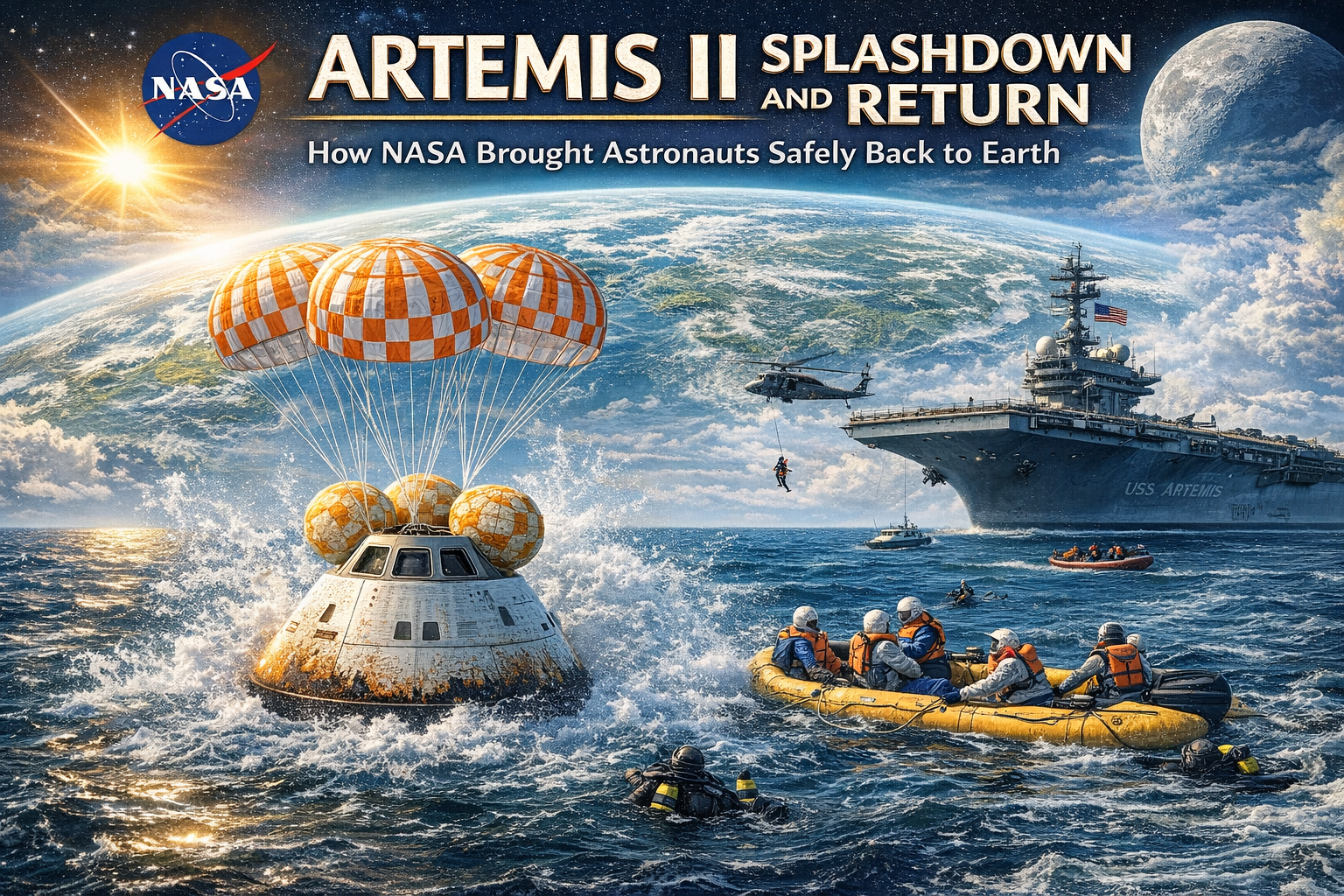
Artemis II Splashdown and Return: How NASA Brought Astronauts Safely Back to Earth
After a historic journey around the Moon, NASA’s Artemis II mission concluded with a dramatic and precisely executed splashdown in the Pacific Ocean, marking the safe return of the first astronauts to travel beyond Earth orbit in more than half a century.
The successful landing was a major milestone for NASA’s Artemis program, which aims to return humans to the Moon and eventually send astronauts to Mars. The mission demonstrated that the agency’s new deep-space spacecraft, Orion spacecraft, can safely transport astronauts through the harsh environment of space and back to Earth.
A Historic Mission Around the Moon
The Artemis II mission carried four astronauts on a 10-day journey around the Moon and back to Earth.
The crew included:
- Reid Wiseman — Commander
- Victor Glover — Pilot
- Christina Koch — Mission Specialist
- Jeremy Hansen — Mission Specialist from the Canadian Space Agency
Together, they traveled nearly 700,000 miles through deep space, testing critical spacecraft systems and collecting valuable data for future lunar missions. (Scientific American)
The mission represented the first time humans had flown near the Moon since the final Apollo program mission in 1972.
Preparing for the Journey Home
As the spacecraft approached Earth near the end of the mission, the astronauts began a carefully planned return sequence.
A key step was a trajectory correction burn, when Orion fired its thrusters for several seconds to refine its path toward Earth. This maneuver ensured the spacecraft would enter the atmosphere at exactly the right angle for a safe descent. (NASA)
Too steep of an entry could cause dangerous heat and pressure, while too shallow an angle could send the spacecraft skipping off the atmosphere back into space.
NASA engineers monitored every detail from Mission Control at Johnson Space Center in Houston.
The Fiery Reentry Through Earth’s Atmosphere
Returning from deep space is one of the most dangerous parts of any mission.
As Orion approached Earth, the spacecraft began its descent traveling tens of thousands of miles per hour. During atmospheric entry, the capsule experienced extreme heat as friction with the atmosphere generated temperatures of roughly 3,000 degrees Fahrenheit. (NASA)
At this stage:
- The crew module separated from the service module
- The spacecraft aligned its heat shield toward Earth
- Plasma built up around the capsule, causing a temporary communications blackout with Mission Control
This short loss of signal is expected during high-speed reentry and lasts several minutes.
Parachutes Deploy and Splashdown Begins
After surviving the intense heat of reentry, the Orion capsule slowed dramatically as it descended toward the Pacific Ocean.
A sequence of parachutes deployed to stabilize the spacecraft and reduce its speed:
- Small drogue parachutes opened first
- Three massive main parachutes followed
- The capsule slowed enough for a safe ocean landing
The spacecraft ultimately splashed down off the coast of San Diego, completing the mission’s final phase. (Scientific American)
Recovery Operations Led by the U.S. Navy
Once Orion landed in the ocean, recovery teams moved quickly.
The operation involved a coordinated effort between NASA and the United States Navy.
Key elements of the recovery included:
- Helicopters surveying the landing area
- Navy divers entering the water to secure the capsule
- Small boats attaching stabilization equipment
- Astronauts being assisted safely out of the spacecraft
The recovery vessel USS John P. Murtha (LPD‑26) served as the primary ship for retrieving both the astronauts and the Orion spacecraft. (NASA)
Once aboard the ship, the astronauts received initial medical checks before traveling back to Houston.
Why Artemis II Matters for the Future of Space Exploration
Although Artemis II did not land astronauts on the Moon, it served as a critical test mission for NASA’s next era of human exploration.
The mission verified several key technologies:
- Deep-space navigation systems
- Life-support systems for astronauts
- The Orion heat shield during lunar-speed reentry
- Recovery operations after ocean splashdown
These tests are essential for the next step in the Artemis program.
The Road to Future Moon Landings
NASA plans to build on Artemis II with upcoming missions.
Future milestones include:
Artemis III
- Planned mission to land astronauts on the Moon
Artemis IV
- Construction of the lunar Gateway space station
The ultimate goal is to establish a sustainable human presence on the Moon while developing technologies that could eventually enable missions to Mars.
A New Era of American Space Exploration
The successful splashdown of Artemis II marks a major achievement for NASA and its international partners.
More than just a technical success, the mission symbolizes a renewed commitment to exploration — returning humans to deep space and laying the groundwork for humanity’s next giant leap.
With astronauts safely back on Earth, attention now turns to the next missions that will take humans even farther into the solar system.