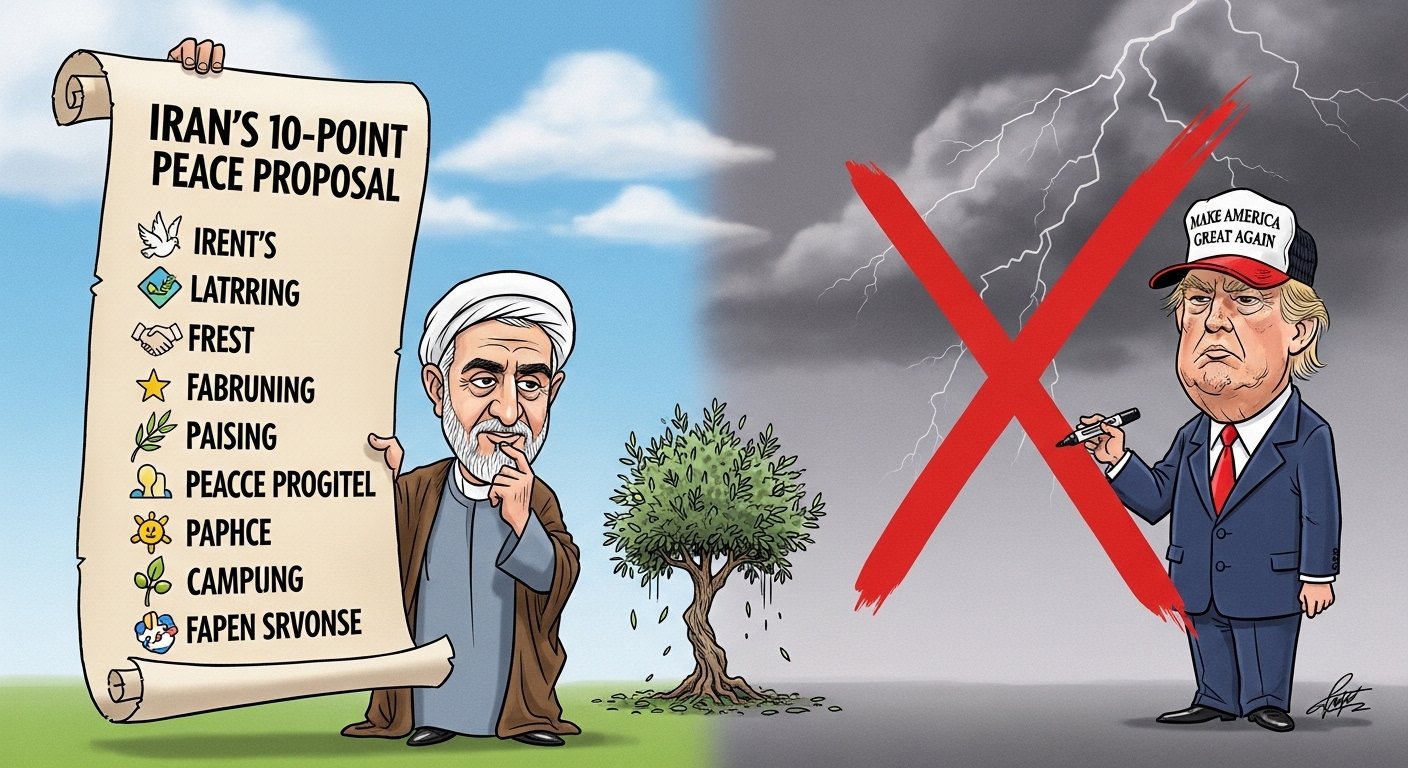
1. Iran’s 10-Point Peace Proposal and Trump’s Response (Rewritten & Expanded)
During the escalating conflict between the United States and Iran in 2026, diplomatic negotiations began after weeks of military tensions. Iran introduced a 10-point peace proposal aimed at ending the war and creating a framework for negotiations with the United States. Former U.S. President Donald Trump described the proposal as a “workable basis” for talks, meaning it could serve as a starting point for discussions even if many details still needed to be negotiated. (Fox News)
Background: Rising Conflict in the Region
The tensions developed during the broader 2026 Iran war, where military strikes, naval confrontations, and political threats escalated across the Middle East. At one point, the United States threatened major strikes against Iranian infrastructure if Iran refused to reopen the strategic Strait of Hormuz, one of the most important shipping routes for global oil. (Wikipedia)
To avoid a larger war, mediators — including Pakistan — helped push both sides toward negotiations and a temporary ceasefire. The result was a two-week pause in hostilities, allowing diplomatic talks to begin. (Wikipedia)
What Iran Included in the 10-Point Plan
Iran’s proposal focused on political, military, and economic demands intended to stabilize the region and end the conflict. While the full details were not publicly released in one official document, reports indicate the plan included several major conditions:
1. Ending the War Permanently
Iran wanted a complete and permanent end to the conflict, not just a temporary ceasefire.
2. Lifting U.S. Sanctions
A major demand was the removal of economic sanctions that have heavily affected Iran’s economy.
3. Recognition of Nuclear Rights
Iran insisted that it should maintain the right to enrich uranium for civilian purposes, which has long been a major point of disagreement with Western governments.
4. Security Guarantees
Tehran wanted assurances that the United States or its allies would not launch future attacks against Iran.
5. Withdrawal of Foreign Military Presence
Another proposal involved the reduction or withdrawal of U.S. military forces from certain bases in the region.
6. Stability in Regional Conflicts
Iran pushed for broader peace efforts across the Middle East, including conflicts involving Israel and Lebanon.
7. Safe Passage Through the Strait of Hormuz
Because the strait is essential for global oil trade, the plan included rules to ensure secure maritime navigation.
8. Economic Reconstruction
Iran proposed international cooperation to rebuild infrastructure damaged during the war.
9. Prisoner Exchanges
The plan also reportedly included humanitarian measures such as exchanging prisoners and detainees.
10. Long-Term Diplomatic Talks
Finally, Iran suggested continued negotiations to establish long-term diplomatic relations and security agreements.
Trump’s Reaction to the Proposal
Trump acknowledged the proposal as a possible starting point for negotiations, but officials in Washington also indicated that parts of the plan were unrealistic or incomplete. Some U.S. officials said the public version of the plan differed from what was privately shared with the White House. (Fox News)
As negotiations continued, the U.S. emphasized its primary goals:
- Prevent Iran from developing nuclear weapons
- Stop missile threats and regional military activity
- Ensure security for U.S. allies in the Middle East
Because of these differences, the proposal did not immediately lead to a full peace agreement.
Ceasefire and Ongoing Negotiations
Despite disagreements, both sides accepted a temporary ceasefire while talks continued. The ceasefire included reopening the Strait of Hormuz, which had major global economic implications since much of the world’s oil passes through the waterway. (Wikipedia)
However, experts warned that the situation remained fragile. Conflicts involving other regional actors — including Israel and groups in Lebanon — made the diplomatic process even more complicated.
Why the Plan Matters
Iran’s 10-point proposal became important because it represented the first structured peace framework discussed during the war. Even though many points were controversial, it opened the door for negotiations that could potentially prevent a much larger regional conflict.
Diplomats believe that future agreements will likely combine parts of Iran’s proposal with conditions set by the United States and its allies.
2. Pentagon Tensions: Dan Driscoll and Pete Hegseth (Rewritten)
A separate political controversy emerged in Washington involving tensions inside the Pentagon between Dan Driscoll and Defense Secretary Pete Hegseth.
Conflict Inside the Pentagon
Reports indicated that disagreements developed between the two leaders over major military decisions during the Iran conflict, including the sudden removal of the Army’s top general. The dismissal of Gen. Randy George, the Army’s chief of staff, shocked many defense officials and created uncertainty within the military leadership. (Wikipedia)
Some officials believed the move could disrupt military planning while the United States was engaged in an active conflict.
Driscoll Responds to Resignation Rumors
Amid speculation that the internal conflict could lead to leadership changes, Driscoll publicly stated that he had no plans to resign from his position. He emphasized that he remains focused on managing the Army during a period of intense military and geopolitical pressure. (Threads)
His statement was meant to reassure both military personnel and policymakers that the Army’s leadership remained stable despite the reported disputes.
Why the Dispute Matters
The situation highlights broader concerns about decision-making within the Pentagon during wartime. Leadership disagreements at the highest levels of the military can potentially affect strategy, coordination, and morale.
At the same time, U.S. defense officials stress that debate and disagreement are normal parts of military leadership — especially during complex international conflicts.
![Here is a **clear rewritten summary of the article** you shared from *The New York Times*, written in a neutral news style for general readers. --- # Jimmy Kimmel Jokes About Melania Trump and Epstein Controversy on Late-Night TV Late-night host Jimmy Kimmel addressed the growing controversy involving Melania Trump and the late financier Jeffrey Epstein during a recent episode of his show, adding comedic commentary to a political story that has dominated headlines in Washington. The segment aired shortly after the first lady delivered a rare public statement from the White House denying any connection to Epstein, the convicted sex offender whose network of wealthy and influential associates has remained a subject of public scrutiny. ## Kimmel’s Late-Night Monologue During his opening monologue on **Jimmy Kimmel Live**, Kimmel joked about the unusual timing of Melania Trump’s public remarks. He pointed out that the first lady’s appearance seemed unexpected, noting that even President Donald Trump reportedly said he had not been aware she would make the statement beforehand. Kimmel’s remarks framed the moment as unusual political theater, suggesting that the surprise speech added another dramatic twist to the ongoing Epstein story. Like many late-night hosts, Kimmel used satire to comment on the situation, mixing humor with criticism of political figures involved in the controversy. ## Melania Trump’s Rare Public Statement The jokes came after Melania Trump delivered a formal address at the White House denying rumors that linked her to Epstein. She firmly rejected claims that she had any relationship with him or his associate Ghislaine Maxwell. Melania said the allegations were **“baseless lies”** and insisted she had never been involved in Epstein’s crimes. She also said she had never been introduced to her husband by Epstein and was not one of the victims in the case. In the statement, she acknowledged that she and Donald Trump had occasionally attended the same social events as Epstein years ago in New York and Palm Beach but said those encounters did not indicate any relationship. ([https://www.kold.com][1]) ## Calls for Congressional Hearings During the speech, Melania Trump also called on Congress to hold public hearings so that Epstein’s victims could share their stories in a formal setting. She said allowing survivors to testify openly would help bring clarity and accountability to a case that has long been surrounded by speculation and unanswered questions. ## Late-Night Comedy and Politics Kimmel’s commentary highlights how late-night television frequently responds to major political moments. Programs like **Jimmy Kimmel Live**, **The Daily Show**, and other comedy talk shows often use satire to discuss political controversies and current events, bringing those stories to audiences in a more informal way. In this case, the Epstein scandal — already one of the most widely discussed political stories in the United States — quickly became material for late-night comedians. ## Why the Story Is Getting Attention The renewed focus on Epstein has been fueled by newly released documents and continuing questions about connections between the financier and powerful figures in politics, business, and entertainment. Although Epstein died in 2019 while awaiting trial, investigations and document releases have kept the case in public conversation for years. Melania Trump’s decision to address the issue publicly — something she rarely does — brought fresh attention to the controversy and sparked reactions across media, including Kimmel’s monologue. --- ✅ If you want, I can also: * Turn this into a **1,500-word SEO news article** * Write a **YouTube news script about Jimmy Kimmel’s comments** * Create **SEO title, meta description, and tags for Google News ranking**. [1]: https://www.kold.com/2026/04/09/melania-trump-delivers-statement-white-house-denying-ties-epstein-knowledge-his-crimes/?utm_source=chatgpt.com "Melania Trump delivers statement at White House denying ties to Epstein and knowledge of his crimes"](https://blogistry.us/wp-content/uploads/2026/04/Jimmy-Kimmel-jokes-about-Trump-and-Epstein.png)