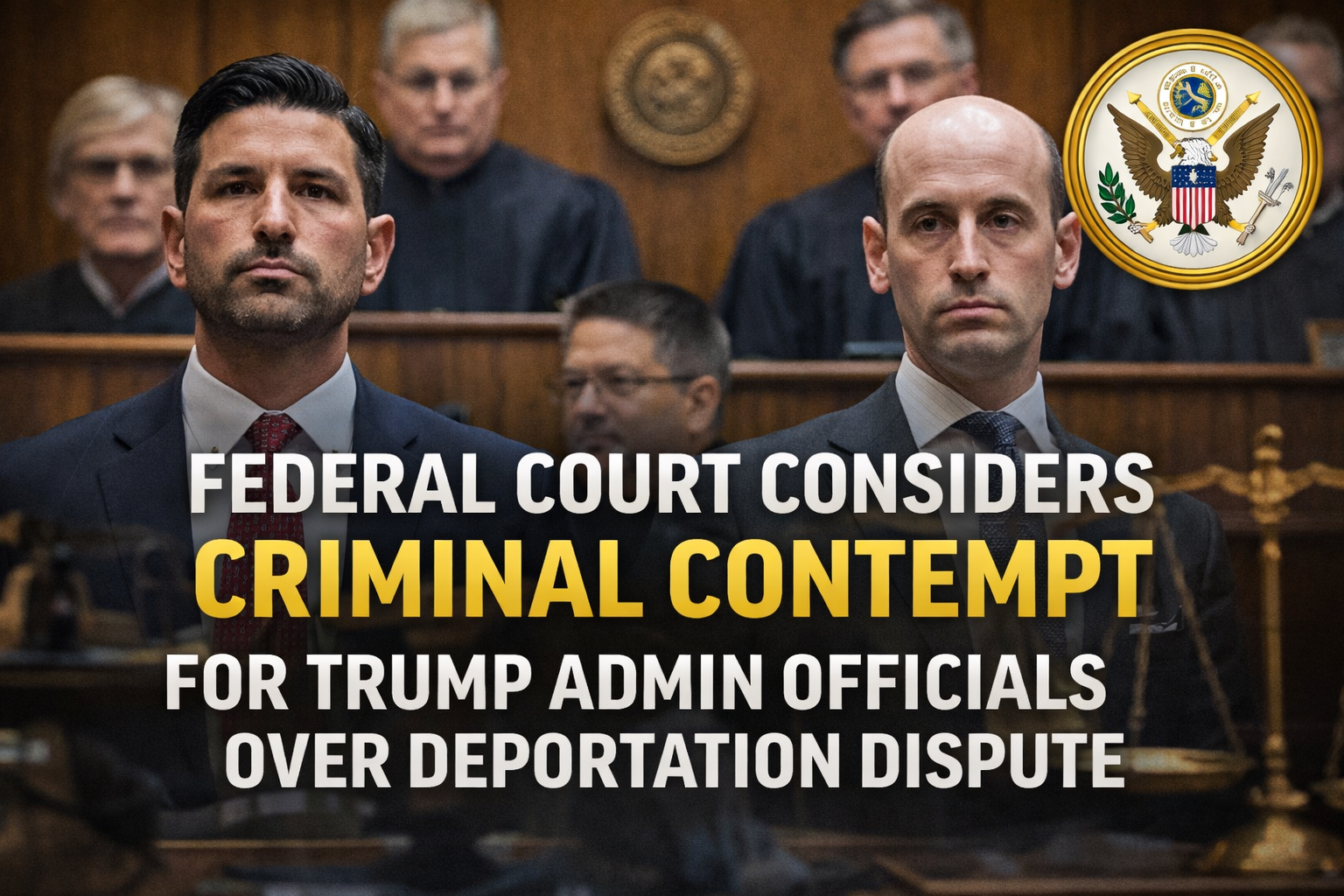
Federal Court Considers Criminal Contempt for Trump Administration Officials Over Deportation Dispute
A federal court is weighing whether to pursue criminal contempt charges against officials connected to the administration of former President Donald Trump, following allegations that government authorities ignored or violated a judicial order related to an immigration deportation case.
The situation has drawn significant attention in Washington because it raises fundamental questions about the limits of executive authority, the role of the courts in enforcing their rulings, and how federal agencies must respond when judges issue orders in immigration cases.
Legal experts say the dispute could become an important test of how the American legal system handles potential conflicts between government officials and the judiciary.
The Core Issue: Alleged Violation of a Court Order
The controversy centers on a deportation case in which a federal judge reportedly issued an order affecting how immigration authorities should handle a specific individual or group of migrants.
According to court filings and legal arguments presented in the case, government officials may have proceeded with deportation actions despite the existence of that court order.
If a court determines that officials knowingly ignored a judicial ruling, the judge has the authority to consider criminal contempt charges. Criminal contempt is a serious legal tool used when a court believes someone deliberately disobeyed or undermined its authority.
Unlike civil contempt, which often focuses on forcing compliance with a court order, criminal contempt is intended to punish past violations and uphold the integrity of the judicial system.
What Criminal Contempt Means in Federal Court
Under U.S. law, criminal contempt is used when a person or entity intentionally defies a court’s authority. If the court finds that such defiance occurred, individuals involved could face penalties that may include:
- Fines
- Additional legal sanctions
- Potential jail time in severe cases
However, legal analysts emphasize that criminal contempt findings against government officials are rare, particularly in politically sensitive cases involving immigration enforcement.
Before any charges are formally pursued, a judge must determine whether there is sufficient evidence showing that the officials intentionally violated the court’s instructions.
Immigration Enforcement and the Courts
Immigration enforcement has long been one of the most contested areas of U.S. policy, often leading to legal battles between federal agencies and civil rights organizations.
During the administration of Donald Trump, immigration policy was one of the most defining and controversial aspects of the federal government’s agenda. The administration implemented a number of aggressive enforcement measures, including expanded deportation priorities and stricter border policies.
Many of those policies triggered lawsuits from advocacy groups, state governments, and immigration attorneys who argued that certain actions violated federal law or constitutional protections.
As a result, federal courts frequently issued rulings that temporarily blocked or modified immigration enforcement actions.
Why the Current Case Is Significant
The present dispute stands out because it focuses not just on immigration policy itself but on whether government officials followed a direct order from the judiciary.
If a judge concludes that the order was ignored or violated, the case could become an important precedent for how courts enforce compliance with their rulings.
Legal scholars say the issue highlights a core principle of American governance: no branch of government is above the law, and executive agencies must comply with judicial decisions even when they disagree with them.
At the same time, officials representing the government may argue that their actions were legally justified or that the court’s instructions were interpreted differently by the agencies involved.
Political Reactions and Public Debate
As news of the court’s consideration of criminal contempt spread, the issue quickly became part of a broader political debate in Washington.
Critics of the Trump administration argue that the situation reflects a pattern of resistance to judicial oversight during disputes over immigration policy.
Supporters of the former president, however, contend that immigration enforcement agencies were acting within their legal authority and attempting to carry out federal law.
These opposing perspectives illustrate how immigration remains one of the most politically polarizing issues in the United States.
What Happens Next
The court will now review evidence and legal arguments from both sides to determine whether criminal contempt proceedings are justified.
Possible next steps may include:
- Further hearings to examine the facts surrounding the deportation decision
- Legal briefs from attorneys representing both the government and the plaintiffs
- A judicial determination about whether the evidence meets the threshold for criminal contempt
If the judge decides not to pursue contempt charges, the case could still continue in other forms, such as civil litigation or administrative review.
If criminal contempt proceedings move forward, the situation could escalate into a significant legal battle involving the Justice Department and potentially higher courts.
Broader Implications for the U.S. Legal System
Beyond the immediate dispute, the case raises broader questions about the balance of power within the federal government.
The United States operates under a constitutional system in which three branches—executive, legislative, and judicial—are designed to check and balance one another.
When courts issue orders, executive agencies are legally required to comply. But disagreements about how those orders should be interpreted can sometimes lead to complex legal conflicts like the one currently under review.
For legal experts, the outcome of this case could influence how future administrations interact with federal courts during disputes over immigration and other national policy issues.
Final Thoughts
As the court continues evaluating the evidence, the case involving potential criminal contempt against officials linked to the Trump administration has become more than just a legal dispute over deportation procedures.
It has evolved into a broader examination of judicial authority, executive power, and accountability within the U.S. government.
The judge’s eventual decision could shape how courts enforce their rulings and how government agencies respond when legal challenges arise during politically charged policy debates.