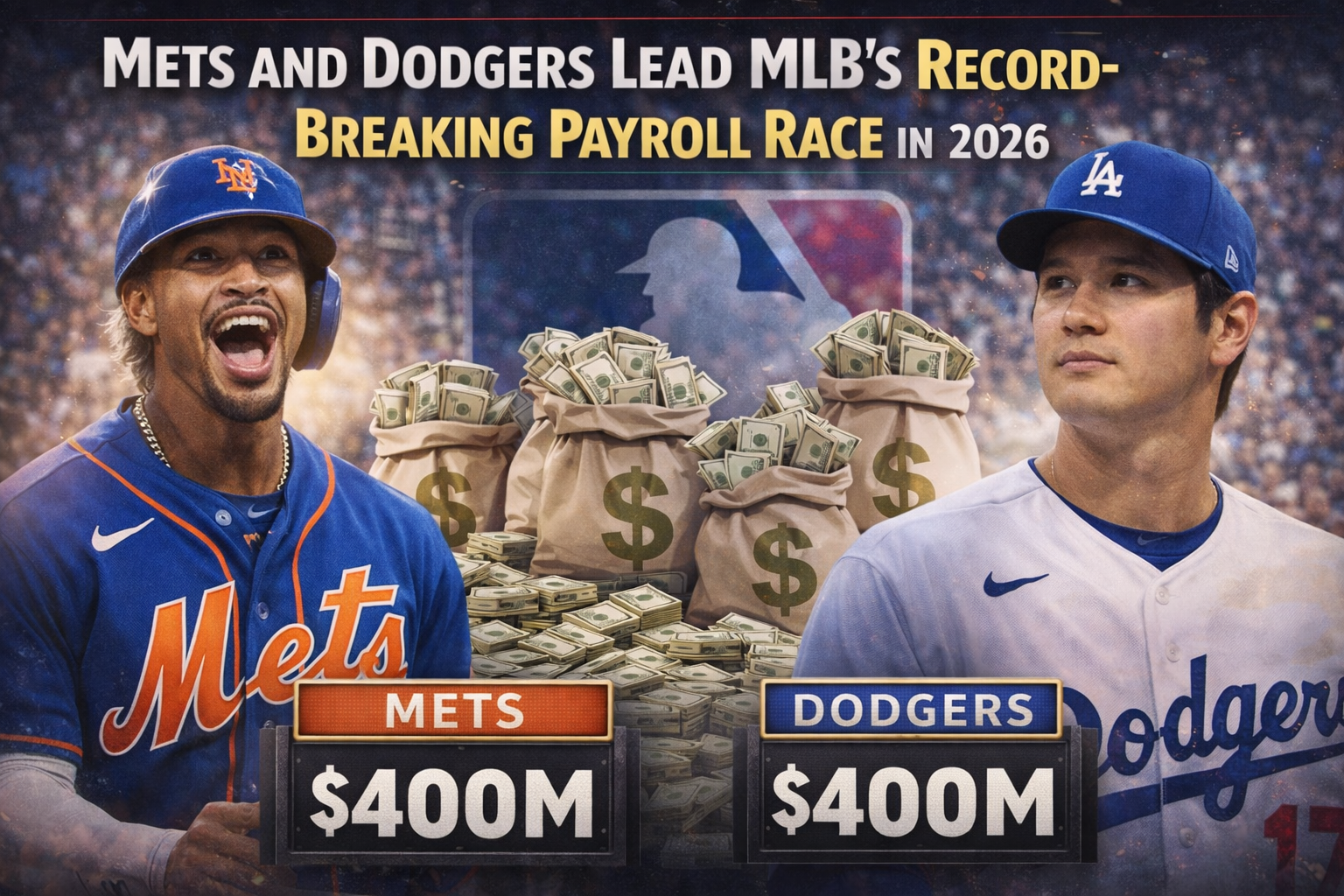
Mets and Dodgers Lead MLB’s Record-Breaking Payroll Race in 2026
The financial arms race in Major League Baseball continues to escalate in 2026, with the New York Mets and the Los Angeles Dodgers once again topping the league in total payroll spending.
As teams chase championships and attempt to build competitive rosters, payroll numbers across MLB have surged to unprecedented levels — highlighting the growing divide between big-market franchises and smaller-market clubs.
For the Mets and Dodgers, massive financial commitments reflect a strategy focused on maximizing their championship windows by investing heavily in star talent.
Mets Continue Their Big-Spending Strategy
The New York Mets have become synonymous with aggressive spending since team owner Steve Cohen took control of the franchise.
Cohen, a billionaire hedge fund manager, has repeatedly signaled his willingness to outspend competitors in pursuit of a World Series title.
Under his leadership, the Mets have assembled one of the most expensive rosters in baseball history, committing huge salaries to elite pitchers, star position players, and veteran leaders.
The strategy has transformed the Mets into one of the league’s most talent-rich teams, though critics argue that high payroll alone does not guarantee postseason success.
Dodgers Maintain Their Longstanding Financial Power
While the Mets have grabbed headlines in recent seasons, the Los Angeles Dodgers remain one of the most consistently dominant and financially powerful teams in MLB.
Backed by strong ownership and one of the sport’s most successful front offices, the Dodgers have mastered the balance between big-name acquisitions and homegrown talent development.
Their payroll reflects the organization’s commitment to remaining a perennial contender in the National League.
Even as other teams attempt to catch up financially, Los Angeles continues to combine star power with one of the deepest farm systems in baseball.
MLB’s Unique Financial System
Unlike leagues such as the National Basketball Association or the National Football League, MLB does not operate with a strict salary cap.
Instead, the league uses a Competitive Balance Tax, often referred to as the “luxury tax.”
This system allows teams to spend beyond a certain threshold but requires them to pay financial penalties if their payroll exceeds league limits.
For wealthy franchises like the Mets and Dodgers, those penalties are often seen as a cost of doing business in pursuit of championships.
Growing Gap Between Big and Small Markets
The soaring payrolls of teams like New York and Los Angeles highlight a long-running debate within baseball: whether the sport’s economic structure creates an uneven playing field.
Large-market teams benefit from:
- Massive local television deals
- Higher ticket revenues
- Corporate sponsorship opportunities
- Larger fan bases
Smaller-market teams often struggle to compete financially, forcing them to rely more heavily on player development and trades rather than expensive free-agent signings.
Some critics argue that MLB should eventually introduce a true salary cap system to promote greater competitive balance.
How Spending Impacts Championship Contenders
While spending big can help assemble talented rosters, history shows that the highest payroll does not always translate into World Series success.
Several teams with lower payrolls have made deep playoff runs by focusing on strong scouting, analytics, and player development.
Still, high payroll teams typically enjoy certain advantages:
- Deeper rosters with experienced veterans
- Greater ability to absorb injuries
- Flexibility to make midseason trades
For the Mets and Dodgers, the challenge isn’t just building an expensive team — it’s converting that investment into championships.
Star Power Driving Payroll Growth
Much of MLB’s rising payroll numbers are driven by the massive contracts signed by superstar players in recent years.
Elite pitchers, power hitters, and multi-position stars are commanding long-term deals worth hundreds of millions of dollars.
These contracts reflect baseball’s continued financial growth, fueled by national television rights, streaming deals, and international expansion.
For top teams, investing in superstar talent is viewed as both a competitive necessity and a marketing opportunity that helps attract fans and boost revenue.
What This Means for the 2026 Season
Heading into the 2026 season, the Mets and Dodgers are once again expected to be among the strongest contenders in baseball.
Both teams feature deep lineups, powerful pitching staffs, and championship aspirations.
However, they will face strong competition from other franchises looking to challenge baseball’s financial heavyweights.
As the season unfolds, fans will watch closely to see whether MLB’s biggest spenders can turn their financial dominance into postseason glory.
The Bigger Picture for Baseball’s Future
The continuing rise in payroll spending is likely to remain a major topic of discussion across baseball.
Owners, players, and league officials will continue debating whether MLB’s current financial structure best serves the sport’s long-term health.
For now, the league remains defined by a mix of big-spending superteams and smaller clubs attempting to outsmart their wealthier rivals.
And in 2026, no teams represent baseball’s financial power better than the Mets and Dodgers.